
How you perceive yourself and who you are attracted to (sexually or romantically) are two important parts of your identity. As you grow up, it’s absolutely normal to be turned on by or develop feelings for both the same and the opposite sex. Doubt and uncertainty are very, very common. Everyone is different and deserves respect for having the courage to be themselves.
If you are experiencing bullying related to your gender or sexuality you can access support through the Anti-bullying Alliance or Family Lives.
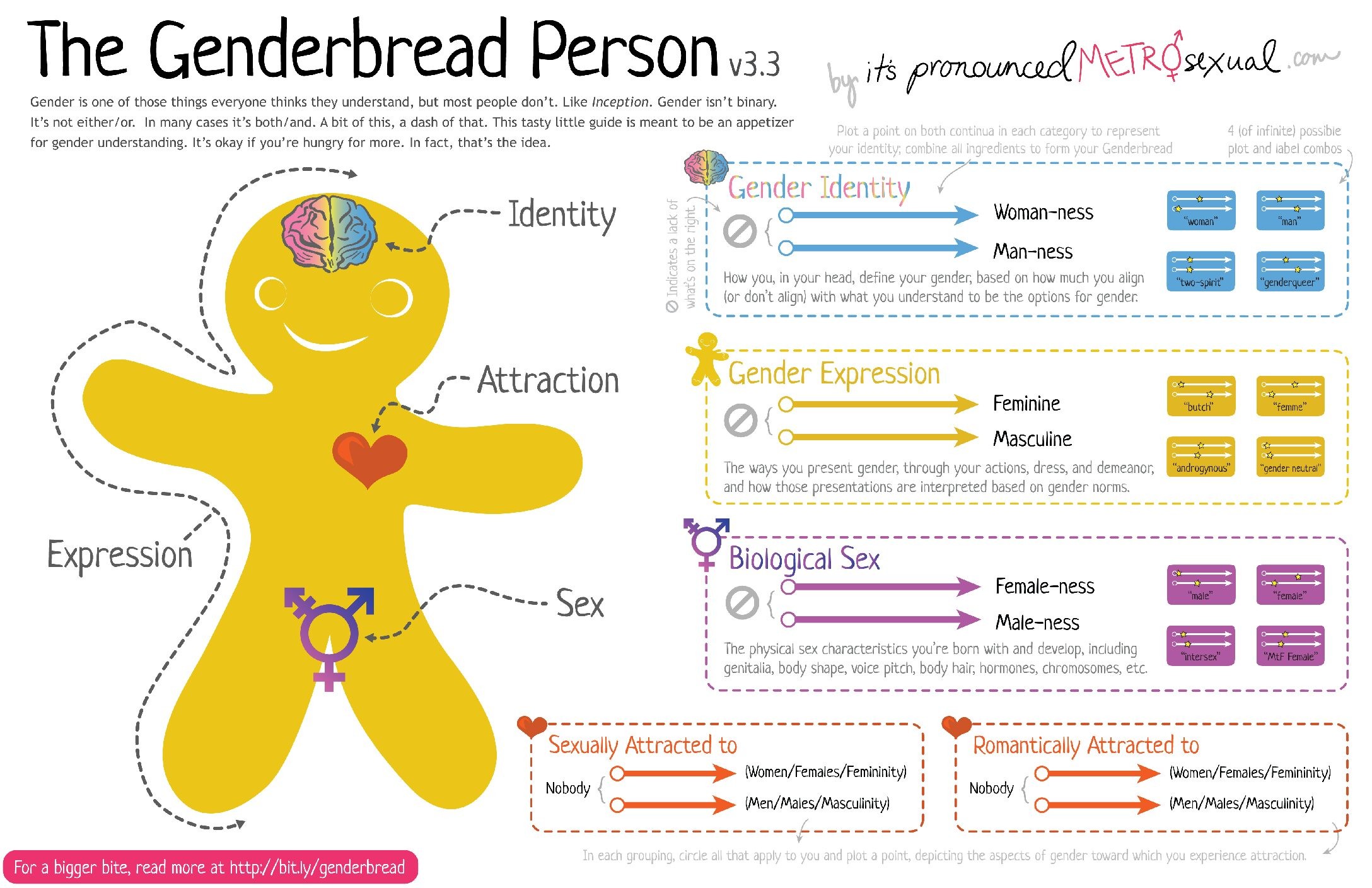
Read more below about gender and sexuality:
Gender Identity & Expression
Unlike anatomical sex, gender identity only depends on how one feels in their body in relation to their gender – it is strictly individual and entirely up to the individual to determine. A person can, for example, be born with a perfectly functioning male anatomy, but still feel like they are a woman, or vice versa. Some people feel like they belong to both genders, neither, or that they fall somewhere in-between.
Cisgender people identify with the sex they have been assigned at birth – boys feel male and girls feel female. This is called being ‘cisgender’, or ‘cis’. Cis (pronounced ‘siss’) is a Latin word that means ‘on this side of’.
Transgender (sometimes shortened to trans) people usually feel like they belong to the opposite gender to the one they have been assigned at birth. So an anatomical female might feel like they are really male, and vice versa. The degree to which they feel that way varies substantially, so trans is really an umbrella term for a whole range of identities.
People may describe themselves as trans if:
-
They were assigned female at birth but recognise themselves to be men. They may refer to themselves as trans men
-
They were assigned male at birth but recognise themselves to be women. They may refer to themselves as trans women
Some trans may choose to socially and/or medically transition. Social transition can involve adopting a new name, pronouns, wearing clothing that better suits their gender identity, and coming out to people in their lives. Medical transitioning is when a trans person undergoes medical surgeries or begins hormone replacement therapy (HRT) to align their physical body more closely to their gender identity. Some trans people socially and medically transition, some only socially or medically, either transition path is valid.
Some people do not feel like they belong to the male or female gender. For example, they may feel somewhere between male and female, both at the same time, or the way they feel simply changes according to the situation. This is, again, strictly individual, but they are generally known as non-binary, genderqueer, or gendervariant.
Please note: while ‘queer’ has recently been used by people to indicate a non-heterosexual or non-cisgender identity, it is traditionally a derogatory term. As such, you should only describe someone as queer if they have asked you to do so first.
Gender expression is the full range of clothing, mannerisms, behaviour and chosen names used to express oneself. It often has nothing to do with a person’s sexual orientation and is sometimes not related to their gender identity either – an anatomical boy can be straight, identify as male, but still enjoy wearing make-up or act in a traditionally feminine way. Similarly, an anatomical girl might wear her hair short and dress in clothes tailored for men, but that does not necessarily mean she is gay or trans. Generally, everyone should have the freedom to express themselves as they see fit.
Sexual Orientation
Sexual orientation is a person’s enduring capacity (or lack thereof) for being sexually attracted to others on the basis of their gender. This might change numerous times throughout your life, or it may remain constant. People who are generally attracted to the opposite gender (heterosexual) can also sometimes experience attraction towards someone of their own and vice versa. In fact, this is extremely common.
Please note: Sexual orientation and sexual behaviour are not always the same thing. A person can engage in a sexual activity with someone of the same or opposite gender for a variety of reasons, without this changing who they are normally attracted to. Who you have previously had a relationship or been sexually intimate with also doesn't change your sexual orientation or make you 'less' of the sexual orientation you are now.
Sexual orientation can be broken up into umbrella terms:
Same-sex attraction: gay and lesbian
Multi-sexual attraction: bisexual, pansexual, omnisexual, queer
A-spec: asexual, allosexual, demisexual, greysexual
Means that you are primarily attracted to people of the opposite gender (for example, people who identify as female and are attracted to males, and vice versa).
Means that you are primarily attracted to people of the same gender (e.g. people who identify as female and are attracted to females, and vice versa)
Means that you are attracted to both the male and female gender.
Historically 'bisexual' was defined as being attracted to both men and women, or two identities. However, the label itself is more inclusive than simply attraction to 'two', now bisexual is defined as an attraction to more than one gender.
Means that you are attracted to all genders and to people regardless of their gender.
Means that you experience no sexual attraction towards anyone (asexual), are only attracted to people that you have formed a romantic/spiritual connection with (demisexual), or only experience sexual attraction occasionally (gray-A).
Romantic Orientation
Romantic orientation is a person’s enduring capacity (or lack thereof) for developing romantic feelings towards others on the basis of their gender. This might change numerous times throughout your life, or remain constant. People who are generally romantically attracted to the opposite gender (heterosexual) can also experience attraction towards someone of their own and vice versa. In fact, this is extremely common.
Romantic and sexual orientation are often linked, but don’t always have to be – there are people who experience sexual attraction to the same sex, but only form feelings for the opposite, or vice versa.
-
hetero-romantic (‘straight’) – means that you are primarily attracted to people of the opposite gender (for example, people who identify as female and are attracted to males, and vice versa)
-
homo-romantic (‘gay or lesbian’) – means that you are primarily attracted to people of the same gender (for example, people who identify as female and are attracted to females, and vice versa)
-
bi-romantic – means that you are romantically attracted to both the male and female gender
-
aromantic – means that you experience no romantic feelings towards anyone
Sexual practices are the physical expression of sexuality. Things like celibacy, masturbation, mutual masturbation, petting, oral sex, anal sex, vaginal sex, fisting, rimming, scissoring, monogamy, polygamy, group sex, etc.
Romantic practices are the expression of romantic interest. Things like engagement, marriage, civil partnerships (as they relate to individuals rather than the law), poly and monoamory, etc.
Biological Sex
Anatomical sex refers to the parts of your body which are used at birth to determine whether you are male, female or intersex/undefined (in some countries). This includes your reproductive organs, hormone levels and/or chromosomal composition (XX for most females and XY for most males).
Intersex is a general term used for a number of conditions, where a person is born with a reproductive or sexual anatomy that doesn’t fit the typical definitions of female or male. For example, a person might be born appearing to be female on the outside, but having mostly male-typical anatomy on the inside. Or they may be born with genitals that seem to be in-between the usual male and female types – for example, a girl with a noticeably large clitoris, or lacking a vaginal opening, or a boy with a notably small penis, or with a scrotum that is divided so that it has formed more like a labia. Alternatively, it also refers to people with mosaic genetics, whereby some of their cells have XX and some have XY chromosomes. Some people live and die with intersex anatomy without anyone, including themselves, ever knowing.
Intersex is mainly used to refer to one’s physicality. While a small number of people choose to identify as intersex, most people with the condition have a stable gender identity.
Coming out
Coming out is when someone tells someone else about their LGBTQIA+ identity. In relation to sexuality, this means telling someone that you are gay, lesbian, bisexual, queer, or any other sexuality which isn’t heterosexual. In relation to gender identity, this means telling someone your gender identity is different to the one you were assigned at birth.
This process exists because we live in a society where most people assume everyone is heterosexual and cisgender.
Coming out is rarely a once-in-a-lifetime event, as many LGBTQIA+ people may want or need to come out to each new person they meet, or may realise different aspects of their LGBTQIA+ identity over time which they might then choose to tell people about.
Being 'outed'
Being ‘outed’ by someone is when someone else shares your identity with others, without your consent. This is wrong; it is always up to you whether you share parts of your identity with others.
Things to think about when coming out
Who should I tell? Consider carefully who you want to talk to about your identity first. This might be a friend or family member who you trust to be supportive, or it might be a trusted adult who you don’t have such a personal connection to. That first conversation can be a great way to experience how it feels to talk about your identity with someone new. Also, that person can then support you as you come out to other people in your life.
When should I come out? There is never a ‘perfect’ time to come out, but there are things you can consider before making that decision.
-
If you are you are juggling other stresses you might not be feeling in the most stable and robust position to come out to people. Also, if you are feeling vulnerable and someone’s reaction is not as supportive as you’d hoped, it could make the other stresses in your life harder to deal with.
-
When planning to have the conversation, it is a good idea to choose a moment when you have the time and opportunity to say what you want to say and to listen to what they have to say. It is rarely helpful to have difficult or emotional conversations when you are in a rush.
-
Have a clear head. If you’re drunk or hungover it is very unlikely that you won’t say the right thing and you may not be in the best state of mind to deal with their response.
-
Avoid coming out in an argument or when you are upset or angry; this could make the conversation heated and stressful than it needs to be.
-
Avoid coming out at big family occasions. These days are often emotional and distracting and you probably won’t get the opportunity to discuss how you feel properly.
-
Consider delaying coming out to your parents if you think this will put you at risk of violence, not being able to live at home, or not being properly cared for until you’ve got a support system that means you can leave and live somewhere safely if you need to.
What do I say? This is completely up to you. Some people may want to detail in great length how they identity, why they feel this way, and how long they've known, whilst others may want to simply share their label and move on with the conversation. Think carefully about what it is you want to say and how you want to say it. You might try writing it down and/or practice saying it aloud. This will help you feel as prepared and calm as possible before talking to someone.
What if someone reacts badly? When you tell people they might be shocked, worried or find it difficult to accept at first. Their first reaction isn’t necessarily how they’ll feel forever; they might just need a bit of time to process what you’ve told them, just as you had to process your own identity.
It is important to take care of yourself in these situations; while it is a good idea to give people time to adjust, you should still be prioritising your own comfort and happiness and seeking support from people who you trust and will be supportive. Coming out can take a lot of mental energy, so ensuring you have space to recharge and collect yourself away from other people is important.
Gender stereotypes
A gender stereotype is a preconceived belief about the characteristics, behaviours, or roles that individuals should have based solely on their gender. These stereotypes are deeply ingrained in society and culture, shaping expectations of individuals and influence many areas of our lives:
-
Personal identity
-
Career path
-
Education
-
Emotional expression
-
Physical expression
-
Relationships
-
Social interactions
Gender stereotypes typically reinforce traditional, or binary, concepts of gender – male and female. These beliefs can be harmful, often leading to unfair biases and prejudices. For example, toys and colours often reinforce stereotypes, such as girls playing with dolls and boys with trucks, or girls wearing pink and boys wearing blue.
Commonly asked questions and myths:
'Are people born gay or do they become gay?'
Both – some people have always known how they identify and who they are attracted to, whilst others may discover this part of their identity years later. Whether someone has been gay for their whole life, or only recently come out, both are valid in their journey and deserve acceptance.
'Bisexual men are really just gay'
Regardless of what label someone uses, no one has the right to question your identity. Sexual orientation is for each of us to define on our own terms, so if someone says they are bisexual, they are indeed bisexual. This myth is harmful as it erases the experiences of bisexual individuals. This is a form of biphobia - prejudice, discrimination, or aversion toward bisexual people or bisexuality as a sexual orientation.
'You can always tell when someone is queer'
Queer doesn't have a look. You can't tell by looking at someone whether they are queer or not, unless the person wears signifiers such as a pronoun-badge to signal to you, their identity.